A Rapid Integration Method for Emotional Blocks and Trauma Processing
Author
Tia Shen
Founder of Somatic Imagery Integration (SII)
Abstract
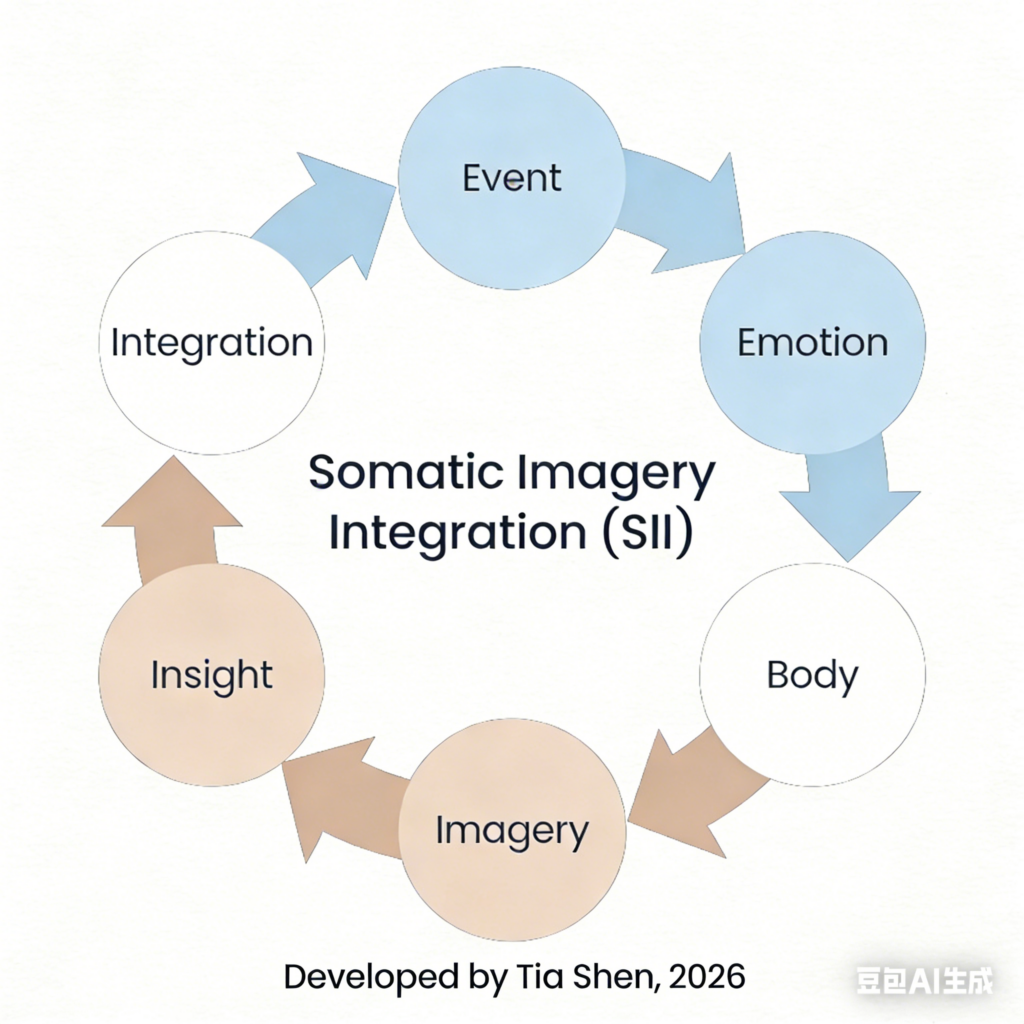
Somatic Imagery Integration (SII) is an integrative method for resolving emotional blocks and trauma-related patterns through a structured process that moves from cognitive awareness to embodied processing and symbolic transformation.
The method guides individuals through a sequence of experiential layers:
Event → Emotion → Body → Imagery → Insight → Integration
By directing attention from external events to emotional experience, bodily sensation, and spontaneous imagery, the process allows emotional material to unfold within the nervous system rather than being addressed solely through cognitive interpretation.
Early observations from practice suggest that many individuals experience noticeable shifts in emotional intensity, bodily tension, and internal meaning structures within a single session. These shifts are frequently accompanied by spontaneous insights and transformations in internal imagery.
Somatic Imagery Integration did not originate from theoretical design. Rather, the framework gradually emerged through repeated patterns observed during direct client work, where similar sequences of emotional processing appeared consistently across different individuals and situations.
Background
Many individuals intellectually understand their emotional patterns yet remain unable to change their behavioral responses or internal reactions.
This gap between knowing and doing has long been observed in psychotherapy, coaching, and trauma-informed work. Cognitive insight alone often proves insufficient for lasting emotional change.
Increasingly, research and practice in trauma and somatic psychology suggest that meaningful emotional transformation requires engagement with the body and the nervous system, rather than relying solely on analytical reflection.
Several established modalities have contributed to this evolving understanding, including:
- Somatic-oriented therapeutic approaches
- Parts-based frameworks such as Internal Family Systems (IFS)
- Emotional Freedom Techniques (EFT)
- Imagery-based processing methods
Somatic Imagery Integration (SII) builds upon insights from these fields while proposing a structured pathway that allows subconscious emotional material to surface through somatic awareness and symbolic imagery.
The SII Integration Pathway
The core structure of SII follows a sequence of experiential layers through which emotional processing unfolds.
The pathway can be summarized as:
Event → Emotion → Body → Imagery → Insight → Integration
Rather than analyzing experiences from the outset, SII allows attention to move gradually from cognitive awareness toward embodied and symbolic levels of experience.
1. Event
The process begins with identifying a specific event, situation, or trigger associated with emotional discomfort.
Working with a concrete event provides a clear entry point into the emotional experience.
2. Emotion
The emotional response connected to the event is then acknowledged and explored.
At this stage the focus is not on altering the emotion, but on recognizing and allowing the emotional experience to be present.
3. Body
Attention then shifts toward bodily sensations associated with the emotional state.
This stage engages somatic awareness and allows the nervous system to access layers of experience that may not be available through cognitive reflection alone.
4. Imagery
As attention deepens into the bodily experience, individuals frequently report the spontaneous emergence of internal imagery.
These images may appear as shapes, objects, symbolic figures, landscapes, or scenes.
Rather than interpreting the imagery intellectually, the process encourages observing how the image evolves or transforms on its own.
5. Insight
As the imagery shifts, individuals often report spontaneous insights or new perspectives regarding the original situation.
These insights typically arise organically as emotional and somatic processing unfolds, rather than through deliberate analytical reasoning.
6. Integration
The final stage involves the natural integration of the emotional experience.
At this point emotional intensity often decreases, bodily tension releases, and the original memory or situation is perceived differently.
Insight, emotional regulation, and embodied understanding converge into a more coherent internal state.
This stage represents the completion of the integration process within the nervous system.
Mechanism Hypothesis
While further investigation is needed, SII appears to involve several interacting mechanisms:
- Regulation of the somatic nervous system
- Memory reconsolidation processes
- Symbolic processing through imagery
- Emotional discharge and completion
- Spontaneous cognitive reorganization
Rather than forcing cognitive reinterpretation, SII allows meaning to emerge organically as the body and symbolic imagery process unresolved emotional material.
Observations from Practice
Early applications of the method have revealed several recurring patterns:
- Individuals frequently report spontaneous imagery when attention is directed toward bodily sensations.
- The imagery often transforms during the session, reflecting shifts in emotional processing.
- Emotional intensity and physical tension tend to decrease as imagery evolves.
- New insights or perspectives often emerge once the imagery resolves.
These observations suggest that symbolic imagery may function as a bridge between somatic experience and cognitive integration.
Applications
Somatic Imagery Integration has been applied in work with:
- Anxiety and panic responses
- Emotional blocks and self-sabotaging patterns
- Trauma-related emotional reactions
- Decision paralysis and internal conflict
- Performance anxiety
Because the method works through embodied awareness rather than purely cognitive analysis, it may be particularly useful for individuals who intellectually understand their challenges but remain emotionally stuck.
Future Directions
Further development of SII may include:
- Practitioner training frameworks
- Systematic documentation of case studies
- Qualitative research on imagery transformation
- Integration with existing trauma-informed approaches
As additional practitioners explore the method, further research may clarify the mechanisms underlying somatic imagery processing and emotional integration.
Conclusion
Somatic Imagery Integration (SII) proposes a structured pathway through which emotional experiences move from cognitive awareness into embodied processing and symbolic transformation.
By allowing insight to arise through the body and imagery rather than forcing analytical reinterpretation, SII offers a framework for facilitating emotional integration in a natural and experiential manner.
Continued exploration and documentation will be important for further refining and understanding the method.
Author Note
Tia Shen is a subconscious integration coach and the founder of Somatic Imagery Integration (SII). Her work integrates somatic awareness, EFT tapping, parts-based exploration, and imagery-based processing to support emotional integration.
SII was developed independently through direct practice before the author became aware of its alignment with existing modalities.
First published: March 2026
Version: 1.0
Enjoyed this article?
Receive weekly reflections and mindset tools designed to help you bridge the gap between knowing and doing.